Team LuMA at the 2nd ESA Space Resources Challenge
A robotic lunar excavation and beneficiation system that collects, transports, and processes regolith, developed for ESA's Second Space Resources Challenge.
- Principal Investigator
- Prof. Dr. Miguel Olivares-Mendez
- Funding
- ESA — Open Space Innovation Platform (OSIP)
- Duration
- 2025
- Researchers
- Dr. Raúl Castilla Arquillo, Dr. Carol Martinez, Dr. Abhishek Bera, Andrej Orsula, Ricard Marsal i Castan
- Partners
- Aalborg University (AAU Space Robotics), Maana Electric
Overview
Sustained human presence on the Moon depends on using local resources. Lunar regolith can be processed to produce oxygen, extract metals, and supply feedstock for additive manufacturing, but it first has to be excavated, transported, and sorted into usable fractions.
The Second Space Resources Challenge, organised by the European Space Agency (ESA) and the European Space Resources Innovation Centre (ESRIC) through the Open Space Innovation Platform (OSIP), focused on exactly this step: autonomous excavation and beneficiation of lunar regolith.
Team LuMA brought together the University of Luxembourg, Aalborg University, and Maana Electric to develop an adaptive robotic excavation system paired with an optimised beneficiation unit. The team was led by Dr. Raúl Castilla Arquillo, who was responsible for team strategy and rover operations.
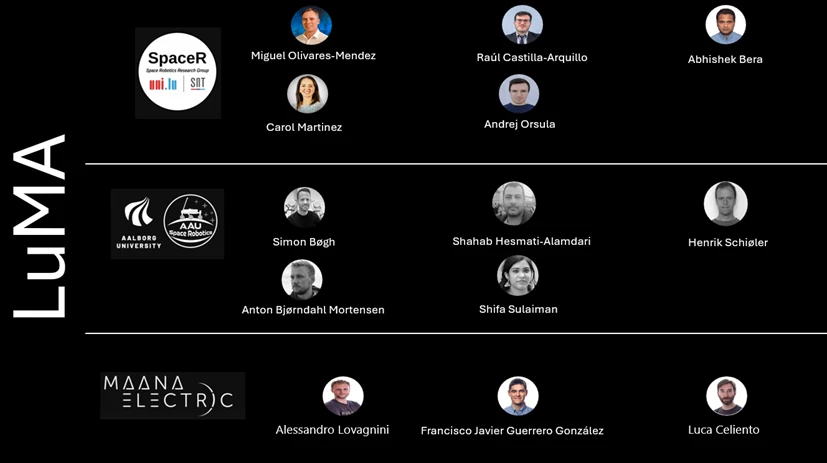
Team LuMA: SpaceR (University of Luxembourg), AAU Space Robotics (Aalborg University), and Maana Electric.
The System
The LuMA system combines a rover with a robotic arm for regolith collection and transport, and a beneficiation unit that sorts the excavated material by particle size. The design addresses the main practical problems of handling regolith: particle segregation, material clogging, and dust.
Field Test
From 13 to 17 October 2025, eight teams from six countries tested their systems at the ESA–DLR LUNA facility in Cologne, Germany. Team LuMA demonstrated the collection, transport, and beneficiation of lunar regolith simulants in the analogue environment. Despite setbacks during the trials, including clogging and loss of communication, the team adapted its operations on-site.
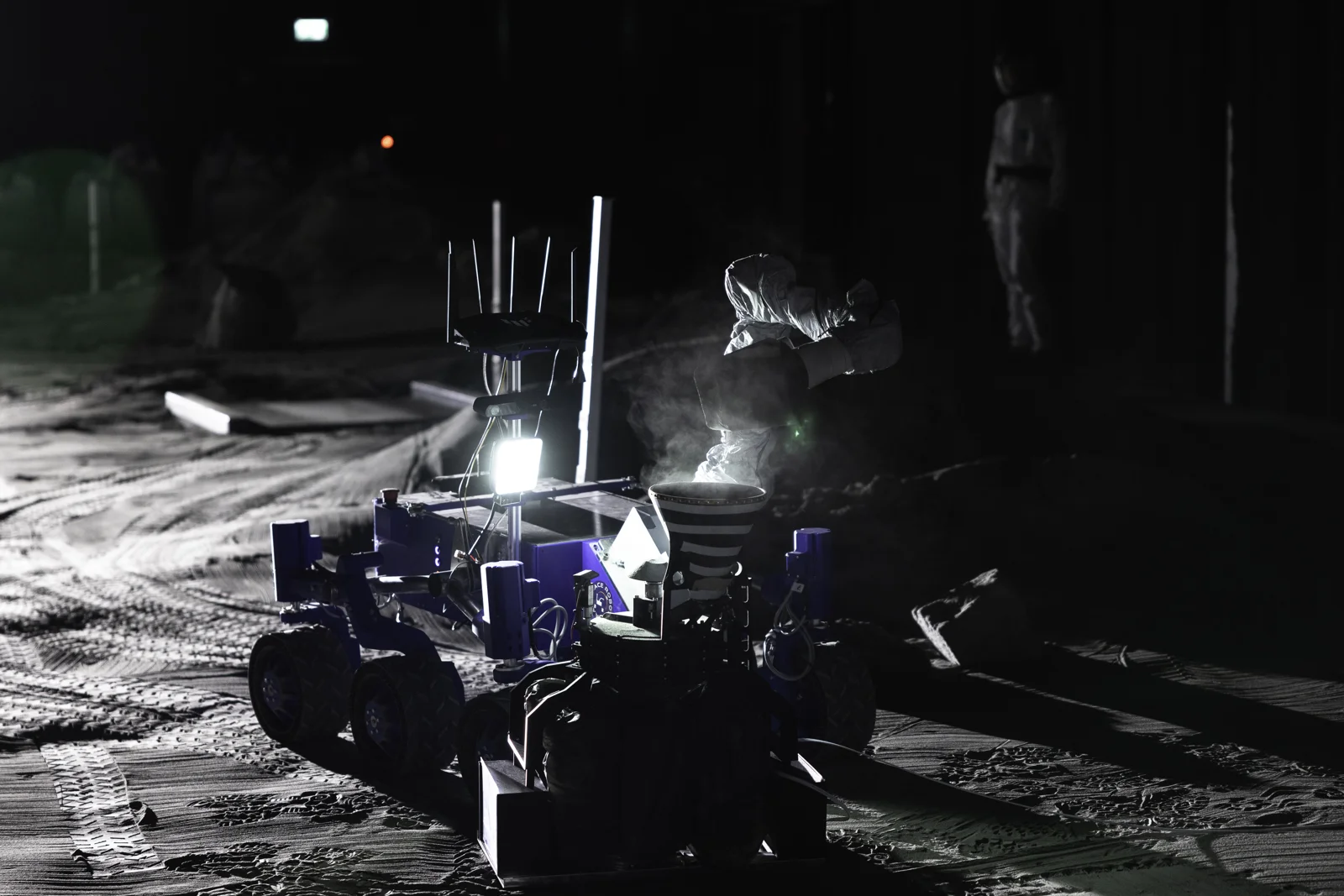
The LuMA rover during the field test at the LUNA facility. Credit: ESA/DLR, R. Barbosa.
Consortium
University of Luxembourg (SnT / SpaceR) — Luxembourg
Team leadership, robotic guidance, navigation, and control, multi-robot collaboration, and robotic manipulation with teleoperation. The LunaLab facility served as a testbed for lunar-like conditions.
Aalborg University (AAU Space Robotics) — Denmark
Perception, robotic control, and multi-agent coordination for excavation and regolith transport.
Maana Electric — Luxembourg
The beneficiation unit, which sorts the excavated regolith by particle size for downstream processing.