Fallback Adaptable Heterogeneous Multi-Robots for Efficient and Collaborative Lunar Prospection
Developing robust and autonomous heterogeneous robotic systems that can anticipate failures, adapt to challenging lunar terrain, and collaborate efficiently during future lunar exploration missions.
- Principal Investigator
- Prof. Dr. Miguel Olivares-Mendez
- Funding
- FNR CORE International — C24/IS/18990533/NeverGiveUp
- Duration
- Jun 2025 – May 2028
- Researchers
- Saki Omi, Riccardo Viviano
- Partners
- ETH Zurich — Robotic Systems Lab
Overview
Future lunar exploration will increasingly rely on autonomous robots to operate in terrain and environmental conditions that are difficult or impossible for humans to access directly. Current robotic systems, however, still have limited autonomy when dealing with challenging terrain, unexpected conditions, and failures.
NeverGiveUp develops a robust and highly autonomous framework for heterogeneous multi-robot lunar exploration. The project brings together wheeled and legged robots with complementary locomotion, manipulation, sensing, and planning capabilities.
The central idea is to enable robotic teams to:
- identify and predict potential failures,
- react before significant damage occurs,
- define, share, and execute tasks collaboratively, and
- adapt their behaviour to local terrain conditions and robot state.
By combining failure-aware autonomy, global mission planning, robust robotic skills, and multi-robot collaboration, NeverGiveUp aims to make future lunar prospection missions more efficient, resilient, and sustainable.
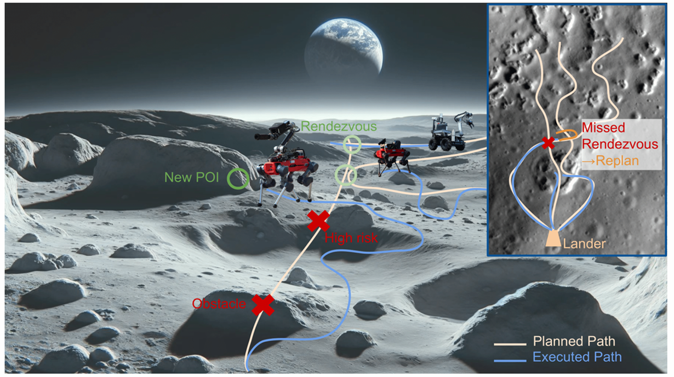
Exemplary view of the NeverGiveUp planning framework, where multiple paths are planned for heterogeneous robots and local environmental information is continuously fused into the global planner to support frequent replanning.
Research Objectives
Failure Detection and Damage-Minimizing Reaction
NeverGiveUp develops AI-based methods to detect, identify, and predict internal robot failures and mobility risks using onboard proprioceptive sensing.
For wheeled robots, this includes situations such as excessive wheel slip, sinkage, entrapment, and degraded mobility. For legged robots and manipulators, the framework also considers internal failures and loss of performance.
The project further investigates reinforcement-learning-based recovery strategies that allow robots to react to critical situations before they result in significant damage or mission failure.
Autonomous Global Mission Planning
The project develops a global mission-planning framework for heterogeneous robotic teams.
The planner combines prior information such as satellite maps with information collected locally by the robots, including terrain properties, scientific targets, robot capabilities, and robot health.
As new information becomes available or robot capabilities change, the mission can be replanned dynamically and tasks redistributed among the robotic team.
Robust Robotic Skills
NeverGiveUp develops robust locomotion and manipulation skills for planetary exploration.
These include sample collection, scientific instrument deployment, object and regolith manipulation, and collaborative tasks that require multiple robots.
The objective is not only to enable these skills under nominal conditions, but also to maintain useful operation under challenging terrain and partial robot failures through adaptive fallback strategies.
Integration and Validation
The different components of NeverGiveUp will ultimately be integrated and evaluated as a complete heterogeneous multi-robot system.
Experimental validation will be performed in lunar analogue environments, including SpaceR's LunaLab at the University of Luxembourg, together with outdoor analogue testing.
The final demonstrations will combine failure-aware autonomy, mission replanning, robust robotic skills, and collaborative exploration.
Consortium
University of Luxembourg — SnT / SpaceR
Project coordination, AI-based failure detection and prediction, reinforcement-learning-based recovery, system integration, and experimental validation.
ETH Zurich — Robotic Systems Lab
Global mission planning, collaborative exploration, legged robotics, and robust robotic skills for planetary exploration.
Publications
- R. Viviano, S. Omi, A. Orsula, and M. Olivares-Mendez. "Fleet-To-Lab: A Transfer Learning Framework For Lunar Rover Slippage Estimation Via Model Fusion." Accepted for presentation at iSpaRo 2026. arXiv